



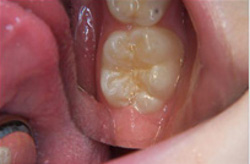
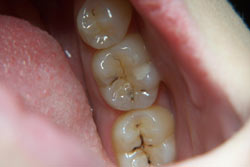
 Patient's tooth before sealant
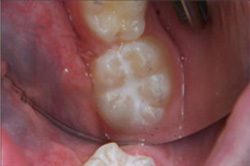
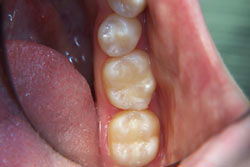
Patient's tooth after sealant
As a preventive dentistry practice, we strive to save your natural teeth and prevent gum disease. Dr. Maron uses the following treatments to accomplish these goals:
- Sealants—Teeth have deep grooves in the biting surface, which are susceptible to decay. In fact, 80 percent of cavities form in these grooves. We seal teeth by cleaning out the grooves and then flowing plastic (called sealant) into these grooves. Patients who have sealants may never have cavities in these teeth as long as they properly maintain them. We evaluate the status of sealants in all adult and baby teeth at every visit.
- Root canal therapy—If the nerve of the tooth becomes infected or irreparably damaged, the nerve will die. To preserve the tooth and counter pain and infection, Dr. Maron performs root canal therapy. He removes the infected nerve tissue and seals the nerve space with rubber. The tooth will no longer be alive; however, it will be functional. Although root canal therapy is the subject of many jokes, new techniques have made it a usually painless and reliable procedure.
- Implantable antibiotics for gum disease—In localized infected areas of the gum, we can insert an antibiotic. This yellow powder contains a time-released antibiotic that kills bacteria in 7-10 days.
- Perio Protect®—This at-home technique treats gum disease with customized mouth trays that deliver medication beneath the gum. It is an easy, inexpensive, and non-surgical approach. A side benefit is that it whitens teeth.
- Fluoride treatment—To reharden tooth that has been softened by decay or acidic foods, we apply fluoride varnish. Fluoride makes the teeth more insoluble in acids, thus strengthening the teeth and deterring tooth decay.
- Evaluation of tooth wear—Dr. Maron looks for loss of tooth structure. Patients can lose tooth structure due to excess acid, grinding of teeth, or excessive wear from tooth brushing with a toothpaste. He may recommend a low abrasion toothpaste such as Pronamel, seeing a physician for antacid medications, or wearing an appliance at night to protect the teeth.
For more information, see our FAQs on tooth and gum problems.
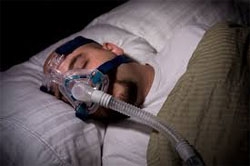
Would you rather wear this CPAP?
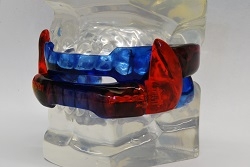
Or would you prefer to wear this oral appliance?
Do you snore? Wake up at night gasping for air? Wake up in the morning still tired after a restless sleep? Fall asleep during the day while working or driving? Are you overweight? If you answered, "Yes," to any of these questions, you might have obstructive sleep apnea; and Dr. Maron can help you.
Obstructive sleep apnea (OSA) is caused by a narrowing of the airway when the tongue is positioned too far back. At least 12-18 million adults in the US have OSA, which causes them to stop breathing hundreds of times a night for a few seconds to more than a minute. Untreated, OSA is a potentially life-threatening condition that can increase the risk for serious health problems, including congestive heart failure, stroke, high blood pressure, heart disease, atrial fibrillation, diabetes, depression, and impotence. A physician determines if you have sleep apnea after a consult and a sleep study. The physician will normally give you a CPAP if you have sleep apnea.
Oral appliances for OSA
Although continuous positive airway pressure (CPAP) is the primary way to treat OSA, about 50 percent of OSA patients do not tolerate a CPAP machine due to the fit of the mask, the noise of the engine, or the noise from the high airflow. For these patients the dentist can fabricate an oral appliance to help treat the sleep apnea. For mild to moderate OSA, the oral appliance is a good alternative to the CPAP. Even with severe sleep apnea, an oral appliance can provide some relief for patients unable to use a CPAP.
Dr. Maron is a Diplomate of the American Board of Dental Sleep Medicine (ABDSM), which is the highest credential a dentist can earn in dental sleep medicine, requiring one year of intensive coursework and culminating in a rigorous exam. He works closely with physicians in the sleep medicine field to make oral appliances to treat sleep apnea.
The oral appliance varies in design but is intended to move the lower jaw and tongue forward. This movement opens up the airway and decreases the snoring and apnea. Unlike the CPAP, the appliance is very portable and does not make noise or need electricity. In addition, unlike with the CPAP, you do not need to take it out for scanning at airport security lines.
For more information, see our FAQs on sleep apnea and read The New York Times article, "For Sleep Apnea, a Mouth Guard May Be a Good Alternative to CPAP."
Teeth before getting plastic fillings
Teeth after getting plastic fillings
Tooth decay has significantly diminished over the years due to fluoride use and healthier diets. However, teeth are still susceptible to decay, infection, and breakage and sometimes need to be restored back to health. Dr. Maron restores teeth using white plastic fillings and white glass iononer fillings.
- White plastic fillings—Dr. Maron uses the Bioclear method for placing most white plastic fillings. He is one of the few certified Bioclear dentists in New York State. Using this system, he injects heated plastic in and around the tooth. This procedure needs less drilling and causes less nerve irritation. It is a more conservative approach that leaves more remaining tooth to hold the plastic. Fillings are stronger, longer lasting, and more aesthetically pleasing.
Dr. Maron tries not to use silver fillings (also known as amalgams) because they do not adhere to teeth, they make the teeth sensitive to cold, and they are ugly. Also, silver fillings act as wedges, fracturing teeth over time.
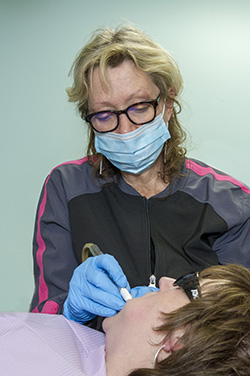
Hygienist doing a dental cleaning on a patient
Regular checkups are important for maintaining your dental health and reducing your potential for large dental problems. The American Dental Association recommends that you see the dentist at least twice a year. We prefer 3-4 times a year for adults because destructive bacteria re-form in three months and cleanings will disrupt them.
At your dental checkup, Dr. Maron and his hygiene team perform the following treatments:
- Dental cleanings and digital x-rays—Our hygienists inspect the gums and bone around the teeth for periodontal disease. They scale the teeth to remove calculus (tartar) from below the gum line, smooth rough surfaces where plaque builds up, and polish the teeth. They also take multiple measurements of the gum around each tooth to ensure early detection of gum disease.
The hygienists take x-rays every two years to detect new dental problems such as decay, abscesses, tumors, cysts, and bone loss. Our digital x-rays require a lower level of radiation than traditional x-rays, making them safer.
- Dental exam, including head and neck exam and oral cancer screening—After the hygienist cleans your teeth, Dr. Maron inspects the teeth for tooth decay or cracks and assesses the condition of old dental work. For children, Dr. Maron checks to see if the new teeth are erupting. He examines every patient’s face, neck, lips, tongue, pharynx, tissues, and gums for any signs of oral cancer. He checks for enlarged thyroid glands, swollen lymph glands, enlarged salivary glands, and any tissue abnormality inside the mouth. Dr. Maron's oral cancer screenings have been instrumental in saving patient lives by detecting cancer in its earliest stages when it is most easily treated.
For more information, see our FAQs on oral health care.
News flash
Dr. Maron is a Diplomate of the American Board of Dental Sleep Medicine (ABDSM), which is the highest credential a dentist can earn in dental sleep medicine.